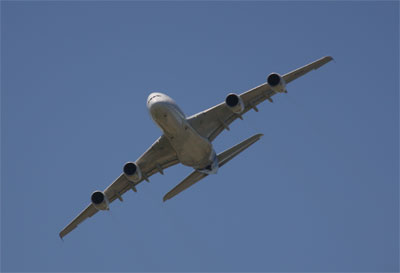
The fear of flying
The majority of people who step foot onto commercial airliners don't understand how these can even fly. Naturally their greatest concern - especially when it comes to fearful flyers - is, "what if something goes wrong when the aircraft is 10,000 meters above ground level?"
1. Statistical facts
 Aircraft manufacturers have to comply with safety statistics requirements as dictated by international organizations. In any modern aircraft, the probability of a catastrophic scenario (of the kind that may lead to a crash) occurring shall not exceed one in a billion per flight hour. A maximum of 100 scenarios of this kind is allowed on any given aircraft type. Moreover, a single failure must not lead to a catastrophic scenario occurring. Should an aircraft not comply with these rates, it will not be certified and will therefore not be able to perform commercial flights.
Taking into account the average flight time (five hours), the odds of being involved in an aircraft accident amount to about one in two million eaxh time you fly. Or you will be involved in a crash every 1,000 years onboard.
2. Plane or car?
In five years (between 2012 and 2017), a total of 1,910 people died in 80 commercial aircraft accidents. This represents an average of about 382 people dying in 16 accidents per year.
In USA, around 32,000 people die in car crashes every year. Of course, more people step into cars everyday than in aircraft. Nevertheless, the fact remains that you are at a far greater risk of being involved in a crash when driving to the airport than when getting on an aircraft. The accepted belief, however, is that people have more control over their fate when in their car than when a passenger on an aircraft.
3. The media contribute to the fear
Media coverage would suggest that aircraft accidents occur on a daily basis. In fact, reports of such accidents are between 150 and 200 times more likely to receive front-page coverage than reports of more common causes of death. Consequently, fearful flyers develop a negative bias towards flying. Their fears become validated by the relentless bombardment of information relating to airline safety following an accident.
4. Are some airlines safer than others?
Yes. The odds of being on a flight which results in at least one fatality vary depending on which airline you are flying with.
| Airlines | Odds of being on an airline flight which results in at least one fatality |
| Top 25 airlines with the best records | 1 in 4.25 millions |
| Bottom 25 airlines with the worst records | 1 in 386,000 |
Two main reasons explain these variations:
1 - Even though all airlines must meet ICAO (International Civil Aviation Authority) safety standards, the control and overseeing of the implementation of these regulations remains under the responsibility of the Civil Aviation Authority of the country in which the airline has set its main base. But the knowledge and organization of those national authorities differ from one country to another. Foreign authorities may perform checks on aircraft landing in their country (and can decide to ground an aircraft as a result), but since only a few aircraft can be controlled, foreign authorities generally trust the authority of the country in which the airline has its main base. For more information, go to the chapter detailing the technical control performed by Authorities on foreign airlines.
For example, if a Russian aircraft lands in Paris (France), the French authorities will be allowed to control and ground the aircraft, should it not comply with French regulations. So many aircraft land in France everyday, however, that they cannot all be controlled. This Russian aircraft is therefore not likely to be checked. The French authorities must therefore trust the Russian Authorities and allow the aircraft to operate in France.
2 - An aircraft manufacturer requests from its customers (i.e. airlines) an actions list, in order to ensure that the aircraft will be safe throughout its life. Such actions lists may include regular checks and a list of mandatory and optional equipment, for example.
Some airlines may decide to add to this actions list. For example, some optional equipment could become mandatory. This improves safety, but it also drastically increases aircraft operating costs.
Some airlines therefore choose not to add their own constraints to the list. The safety of these airlines will be at its lowest acceptable level.
It can happen that an airline manifests dangerous actions or non-compliance with the regulation. If such an airline is not grounded by its supervisory authority, the European Commission will put it on its blacklist.
Similarly, when Europe cannot get enough evidence that a country's civil aviation authorities are doing its job properly, it will put all airlines in that country on its blacklist.
The public is therefore invited to consult this airlines blacklist before booking their trip.
5. Conclusion
The safety of a flight varies based on the country an aircraft belongs to, as well as on the airline's safety policy. Most airlines meet basic safety standards, as required by the ICAO. Among these airlines, some decide, in spite of additional costs, to introduce their own safety standards, in addition to the ICAO's, and in so doing increase their safety levels.
There is a lack of information in the media regarding aircraft safety. As aircraft crashes are more spectacular and more profitable, these make front-page news, leading to people developping a fear of flying.
Next time you board a commercial aircraft though, remember: airtravel is the safest of all means of travel.